ITA Logistica
The operations system an Italian haulage company runs on, live in production, with native driver apps on the App Store and soon on Google Play.
- What
- Live platform and driver apps
- When
- May 2026 to November 2026
- Stack
- React, Express, SQLite, SwiftUI, Kotlin, Jetpack Compose, Docker
- App Store
- Get the driver app
The client
ITA Logistica is a road-haulage company in Italy. The office plans the week, the drivers run it, and everything in between, from fuel to invoices, used to live in spreadsheets, portals and phone calls. This system is what they run on now, every day, in production.
What I built
The office platform, a web app covering the full operational cycle:
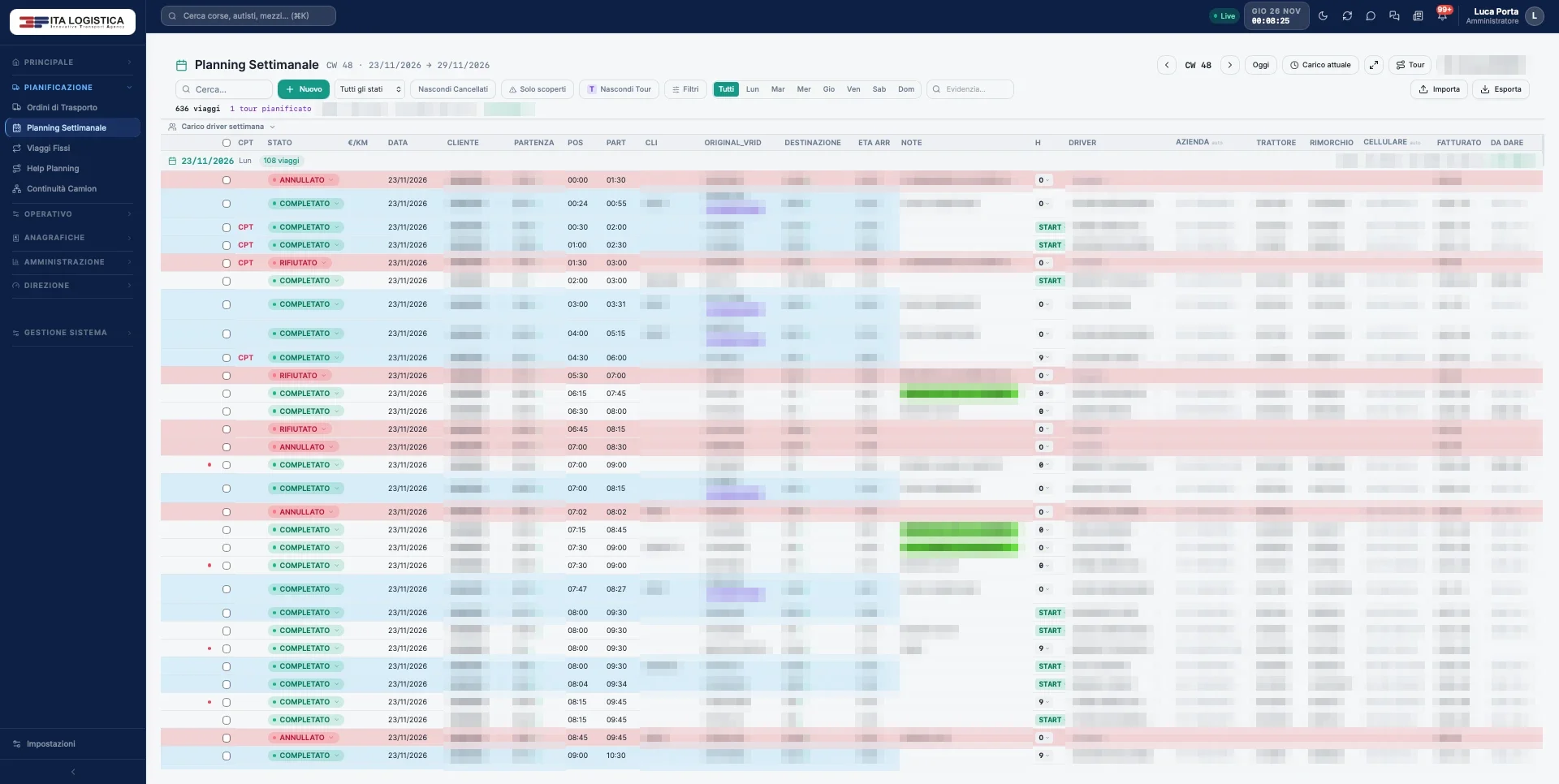
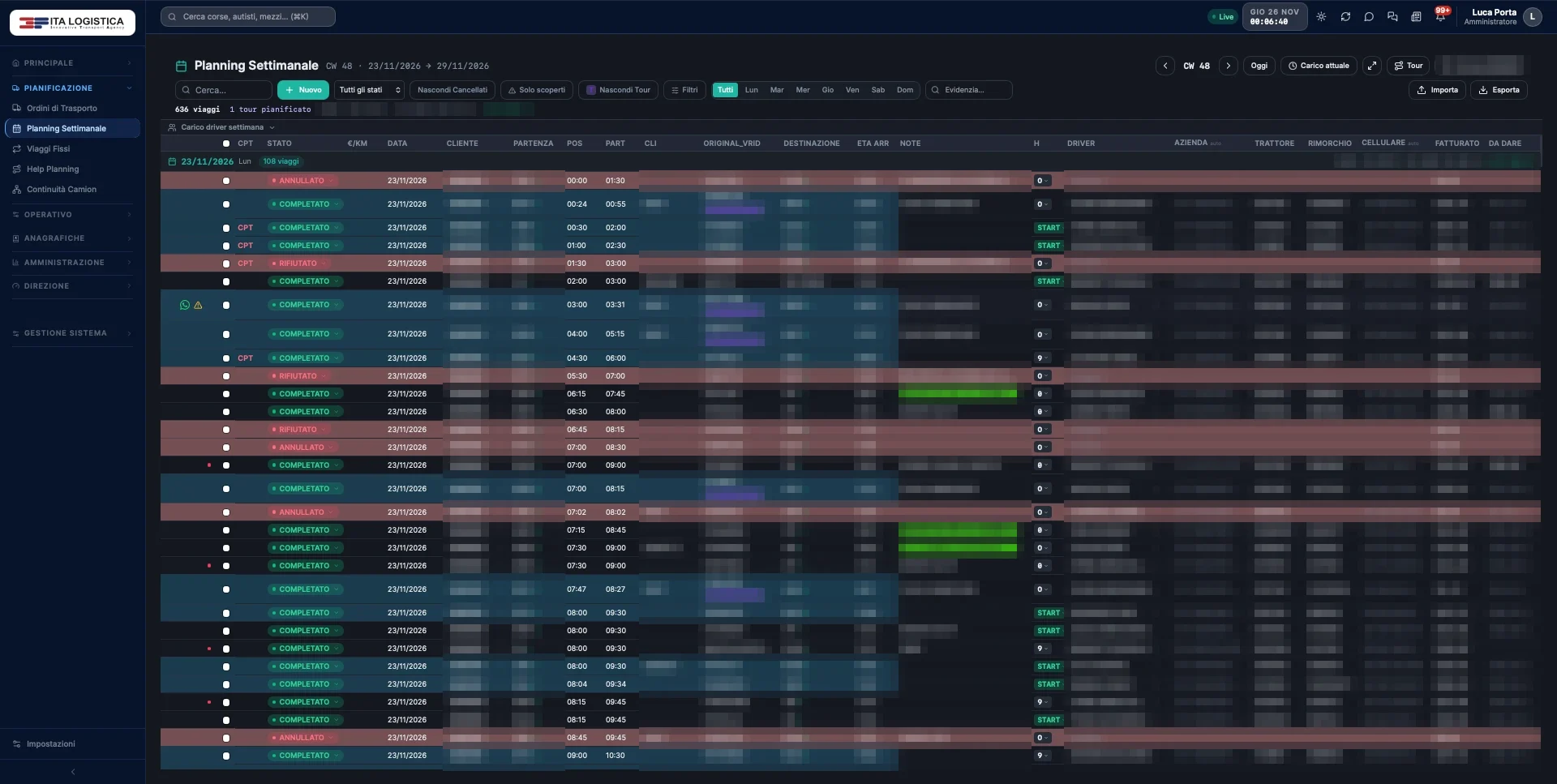
- Weekly planning: the trip grid with states, driver and vehicle assignment, CSV imports from shippers and margin per trip
- Drivers, fleet and warehouses: records, attendance, salaries, tractors and trailers with their deadlines and costs
- Clients and sub-carriers: reconciliation of runs against shipper contracts, pre-invoices and disputes
- Money: cash flow and payment schedule, fuel-card and toll imports per vehicle and driver, billing control
- Suppliers and chat: workshops and parts, and a team chat with live updates over server-sent events
ITA Autisti, the drivers’ app, native on both platforms: SwiftUI on iOS, published on the App Store, and Kotlin with Jetpack Compose on Android, being prepared for Google Play. Drivers see their assigned trips, confirm and start them, and complete each one by photographing the CMR pages, which arrive in the office as a single PDF. They open navigation to the next stop, ask for fuel authorisation and log the fill-up with two photos, report where they left the trailer, and chat with the office, with push notifications for new trips, fuel answers and replies. Italian, English, Romanian and Arabic, right to left included, in light and night mode.
Notes on the hard part
Location without surveillance. Knowing where a truck is matters to the office; in Italy, monitoring employees is regulated (article 4 of the Statuto dei Lavoratori), and Apple reviews location use closely. So the server decides: positions are collected only if tracking is switched on for that account and a trip is in its window, from an hour before departure until the CMR is sent. The app asks only for “while using” permission, keeps the iOS blue indicator visible, explains what, when, who and for how long before the system prompt appears, and works the same if the driver says no. The moment the CMR is sent, tracking stops.
Three clients that never drift. The iOS and Android apps mirror the drivers’ web portal screen for screen, on the same API. Their translations are generated from the portal’s by a script, so a wording change lands in all three at once instead of being fixed three times.
Shipping it. It runs on Docker Compose: the API, the web app, Caddy for
HTTPS, a local AI model and a backup sidecar. Every push to main passes CI
and deploys itself to the production server over SSH.
Notes
More than 1,800 commits since May 2026 and 86 backend test files. The code is private and the screens show ITA Logistica’s real operations, so none are published here. Happy to walk through it on request.